

I looked at every beta reader platform on the market. Here's what I found — and why I ended up building my own.
A honest breakdown of BetaBooks, BetaReader.io, StoryOrigin, and Scribophile — from someone who used them all before deciding none of them were quite right.

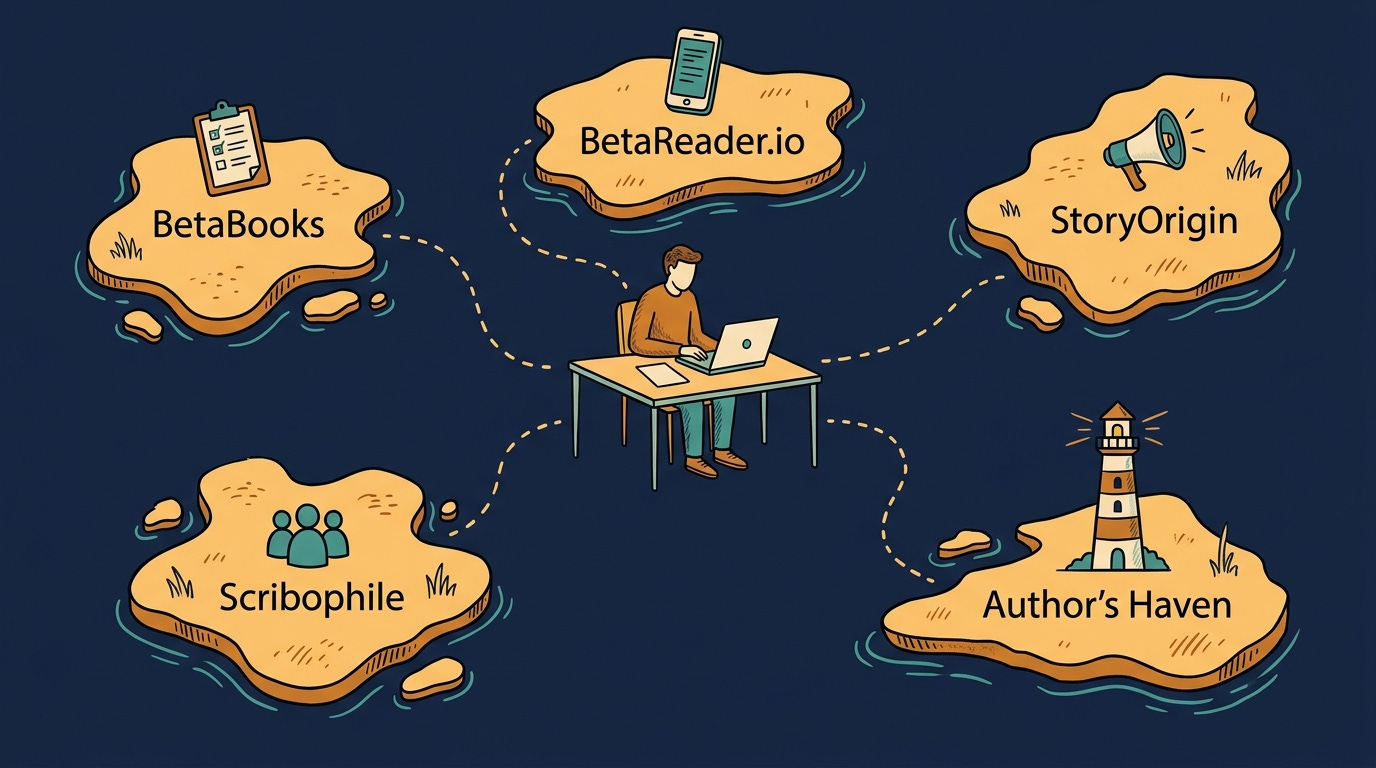
I need to be upfront about something before this article goes any further.
I built Author’s Haven — a beta reader management platform for indie authors. That means I have an obvious financial interest in how this comparison lands. I’m telling you that now, in the first paragraph, because you deserve to know it and because the rest of this article only has value if you trust that I’m being straight with you.
What I can offer that most comparison articles can’t is this: I didn’t evaluate these platforms as a reviewer looking for something to recommend. I evaluated them as someone trying to understand what was missing from the market badly enough to justify building something new. That means I looked hard for what each platform does well — because understanding the competition honestly is the only way to know whether you’re actually building something worth building.
Here’s what I found.
The market is smaller than you’d think
When most indie authors go looking for a beta reader tool, they find the same four or five names. The space hasn’t had a significant new entrant in years. That’s partly because the audience is specific — authors managing pre-publication feedback is a niche within a niche — and partly because none of the existing tools have grown large enough to attract serious competition.
That’s the market context. Now the tools themselves.
BetaBooks: the reliable workhorse
BetaBooks has been around since 2017. It’s a two-person team in San Francisco, and it shows in the best possible way — the product is focused, clean, and doesn’t try to be everything. You share your manuscript, readers leave feedback, you triage it.
The triage system is genuinely good. Marking feedback as To Do, Consider, or Ignore and then filtering by reader or chapter or keyword is the kind of simple-but-correct design decision that takes years of user feedback to get right. Authors who’ve been using it since 2018 are still using it in 2026, which tells you something.
What BetaBooks doesn’t do: EPUB import (you copy-paste everything manually), multiple pen names, NDA workflows, feedback categorisation by type, AI features of any kind, or mobile apps. The most recent post on their blog is a December 2024 notice about database instability. The product is alive but slow-moving.
If you’re a single-name author with a trusted group of readers and you need somewhere clean to collect feedback — BetaBooks works. It just hasn’t evolved much.
BetaReader.io: the best idea, the roughest execution
BetaReader.io made a smart bet early: build a public-facing reader marketplace so authors don’t have to bring their own audience. Readers browse available manuscripts, request access, authors approve them. For debut authors with no newsletter and no writing group, this is genuinely useful infrastructure.
The analytics are also the best in the space. Time spent per chapter, drop-off graphs showing exactly where readers disengaged — this is the kind of data that tells you things individual feedback comments can’t. Spotting that forty percent of your readers quietly stopped at chapter seven is more useful than any single critique.
The problem is the execution. The Android app hasn’t been updated since April 2022. It has roughly a thousand installs and a 2.8 out of 5 star rating, with reviews describing login failures, disappearing comments, and reading progress that doesn’t track past chapter one. One paying subscriber wrote in January 2025 that the platform had been inaccessible for hours every day, that she’d lost a beta reader who gave up after three failed login attempts, and that features were being blocked despite her active subscription.
The iOS app is better maintained. The web platform works. But when readers encounter problems they stop reading, and then your beta round collapses regardless of how good the software is on a good day.
BetaReader.io also has no pen name support, no NDA workflows, no feedback categorisation, and no AI analysis. The blog’s last substantive posts are from mid-2023. There’s a companion AI tool on a separate domain that suggests the team’s focus has shifted — but the core platform is showing its age.
The best version of BetaReader.io would be excellent. The current version is frustrating in ways that cost authors real beta rounds.
StoryOrigin: not really a beta tool, but everyone uses it as one
StoryOrigin is a book marketing platform — newsletter swaps, group promotions, ARC distribution, reader magnets, direct ebook sales, website builder. It’s run by a solo founder named Evan Gow who is, by all accounts, exceptionally responsive and genuinely good at what he’s built. For indie authors who publish regularly and need a marketing infrastructure, it’s one of the best tools available.
Beta reading is a module inside that marketing suite. Authors create a landing page, readers apply, you approve them, they read chapter by chapter in browser. The chapter-gating feature — where readers must complete feedback on the previous chapter to unlock the next — is clever. The ARC reviewer tracking system, with automated post-launch reminder emails and public reviewer history, is the best available for indie authors.
But the beta reading module has real constraints. Inline comments are capped at 240 characters — a hard limit that experienced beta readers bump into constantly. There’s no way to communicate with readers inside the platform. The daily digest email sent to beta readers can’t be disabled, which some readers find intrusive. There’s no NDA gate, no feedback categorisation, no AI analysis, and no pen name support within a single account.
StoryOrigin is worth the $10 a month for most indie authors — but for the beta reading specifically, you’re using a secondary feature with meaningful limitations. Many authors use it for ARC campaigns and switch to something else for beta reading. That’s probably the right call.
Scribophile: a different thing entirely
Scribophile is not a beta reading platform. It’s a writing critique community — one of the largest and most active online, running since 2008 — and comparing it directly to the others misses what makes it valuable.
The karma system works like this: you critique others’ work to earn points, then spend those points to post your own work for critique. Every piece posted to the Spotlight queue gets a guaranteed minimum number of critiques. For writers who don’t yet have an audience and need feedback on their craft, this is a real and rare guarantee.
Several traditionally published authors with major deals credit Scribophile as foundational to their development. The community is active, the forums are substantive, and the inline critique system is well-designed for chapter-level workshopping.
The limitations are structural. The 4,000-word posting cap means novels get workshopped in fragments, which is poor for feedback on overall arc, pacing, or structure. Work posted to the main Spotlight is visible to all logged-in members — a real privacy consideration for authors with unpublished commercial manuscripts. The karma system creates friction: spending time critiquing strangers’ work before you can access your own dashboard is a meaningful time cost for working authors with deadlines.
Scribophile is for a specific stage — craft development, community building, early feedback from fellow writers. It’s not a pre-publication beta tool and it doesn’t try to be.
What I learned building something new
After looking at all of this, what I found wasn’t that every tool was bad. Most of them are good at what they do.
What I found was a set of gaps that appeared consistently across all of them — and that kept coming up in author communities when people talked about their beta reading frustrations.
No platform handled multiple pen names with real data isolation. Authors who write romance under one name and thrillers under another have no clean solution — BetaBooks doesn’t support it, BetaReader.io doesn’t support it, StoryOrigin requires a separate paid account per pen name.
No platform had a formal NDA or agreement gate. Sharing unpublished manuscripts with strangers requires some kind of formal acceptance — but every tool in this space either ignores that entirely or tells authors to sort it out themselves with a Google Form.
No platform let readers categorise feedback by type at the point of entry. Every tool delivers feedback as an undifferentiated pile. Filtering pacing comments from grammar notes from character feedback is entirely manual.
No platform had AI-assisted feedback analysis. With thirty or more beta readers across a long manuscript, the synthesis phase — reading everything before you can start editing — takes days. That’s a solvable problem.
Those four gaps became the core of what I built. Author’s Haven has pen name isolation, NDA gates with AI-generated templates, feedback categorisation (Plot, Character, Pacing, Dialogue, World-building, Grammar, General), and opt-in AI feedback analysis at the chapter level.
It also covers the standard functionality — EPUB import, chapter locking, version history, inline emoji reactions, text comments, triage system, reading progress tracking, per-chapter surveys, reader health scores, smart nudges, ARC management, and a reader marketplace. Pricing is free for one book and five readers, Pro at $14.99 a month, Business at $39.99.
Which tool should you actually use
Here’s the honest version, without the marketing:
Use Scribophile if you’re earlier in your writing development and need craft-level feedback from other writers. The community is real and the feedback guarantee is unusual in the market.
Use StoryOrigin if you’re publishing regularly and need a marketing suite. The ARC system and newsletter swap infrastructure are the best available for indie authors. Use the beta reading module if your rounds are small and your readers are trusted — but know its limitations.
Use BetaBooks if you want something minimal, proven, and unpretentious. One pen name, trusted readers, clean interface. It does the core job without fuss.
Use BetaReader.io if finding readers from scratch is your immediate problem and you’re willing to work around the app instability. The marketplace head start is real. The execution needs work.
Use Author’s Haven if you write under more than one pen name, you’re sharing work with readers you don’t know personally and need a formal agreement gate, you’re running large rounds and need AI to help with synthesis, or you want feedback organised by type before you start editing.
And if you’re still not sure — most of these tools have free tiers. Try them. The right answer is the one that fits how you actually work, not how any comparison article says you should work.
Author’s Haven is at authorshaven.io. I built it, I’m biased about it, and I’ve tried to be honest about that throughout this piece. If you have questions about any of these platforms — or want to tell me I got something wrong — reply to this email. I read everything.
Great article! Really appreciate how the pros and cons of each platform was outlined--it was easy to follow and very informative
What does Author's Haven have to incentivize beta readers?