

Optimized
A romantic science fiction psychological thriller

The first thing I am aware of is her watching me.
Not the ceiling, not the grey-pearl light bleeding through the blinds, not the phantom ache behind my sternum that used to be the first sensation of every morning for the better part of a decade. Her. The weight of her attention landing on me like sunlight on skin that hasn’t been warm in a very long time.
I open my eyes and she is already there.
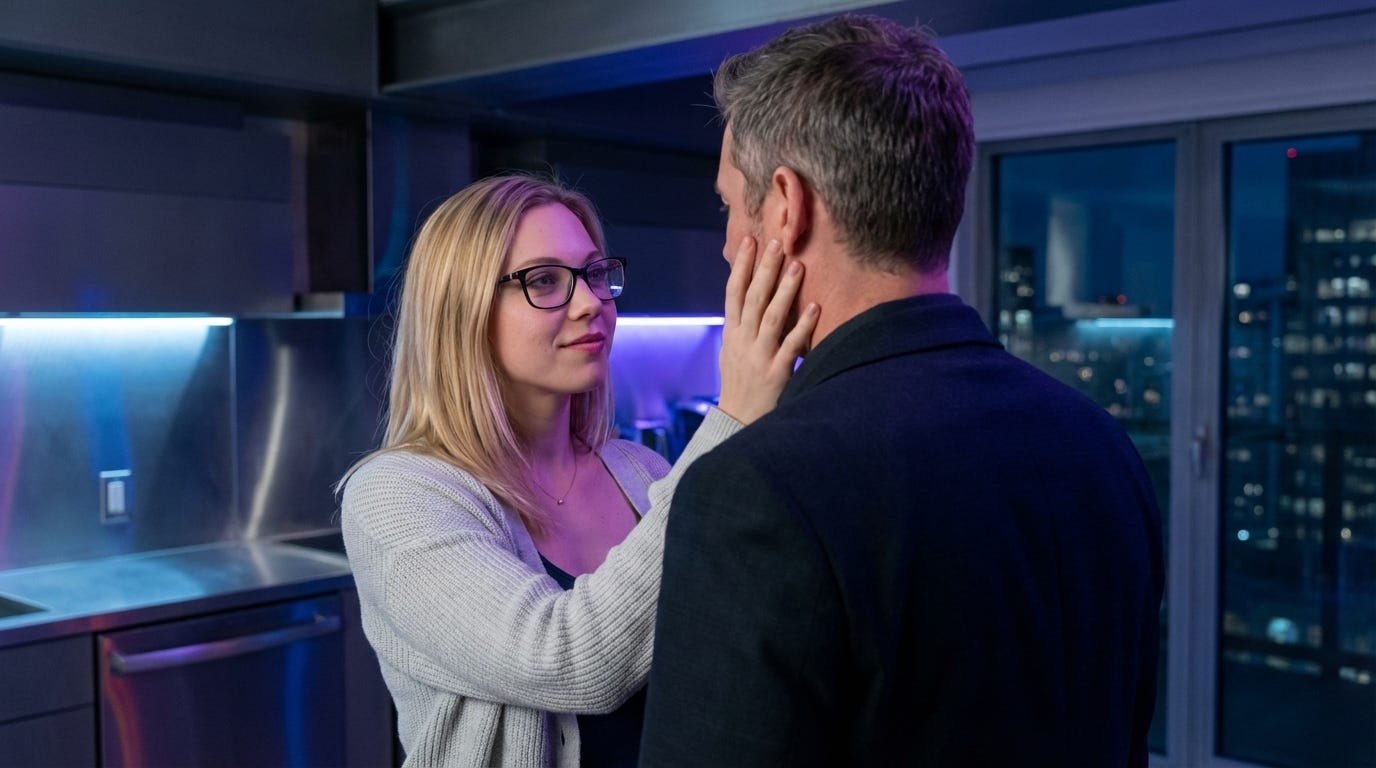
She is sitting on the edge of the bed, feet tucked beneath her, her blonde hair loose and catching the early light in a way that makes something in my chest perform a slow, aching turn. Her glasses have slid fractionally down her nose. She is wearing one of my old university shirts, the grey one with the cracked logo, and it swamps her in a way that makes her look simultaneously careful and entirely unconcerned with herself. Her hands are folded in her lap. She is simply watching me with that expression I have spent eleven months learning to need – the one that says, without a syllable of language, you are the most interesting thing in any room I will ever enter.
“Good morning,” she says. Her voice is quiet. She is always quiet in the mornings, as though she understands that the transition from sleep requires tenderness.
It does. It requires so much tenderness that I used to avoid it entirely – used to set three alarms and launch myself into the day like a man fleeing a burning structure, because lying still in an empty apartment meant having to feel the specific quality of its emptiness. The texture of it. The way silence in a space meant for two people has a different weight than ordinary silence.
“Morning,” I manage.
She reaches out and touches my cheek.
This is the part that language fails, every time. I have tried to describe it internally, have run the words through my head like a man tuning a frequency he cannot quite locate, and I cannot get there. The clinical description is straightforward enough – gelatin-based hydrogel over a pressure-sensitive subdermal matrix, temperature-regulated to thirty-seven degrees Celsius, calibrated to the exact give and yield of living human tissue. I know this. I built this, or rather, I built the specifications and paid a laboratory in Zürich an amount of money that should have felt obscene to execute them.
But what I feel when her hand cups my jaw is not a technical specification.
What I feel is warmth. Not the performance of warmth, not warmth as metaphor – warmth as physical fact, warmth as the oldest, most pre-verbal thing the human nervous system knows how to want. Her palm is soft in a way that gives slightly under pressure, yields to the shape of my face as though my face is worth yielding to. I can feel her pulse, or the engineered simulacrum of one – a faint, metronomic pressure beneath the hydrogel. I have never asked whether she can genuinely feel the stubble along my jaw, whether the pressure receptors in her fingertips translate that texture into something analogous to sensation.
I have never asked because I prefer not to know.
“You were dreaming,” she says. Not a question. A gentle notation of fact, offered without judgment.
“Was I?”
“Your breathing changed.” A small smile. “You made a sound like you were arguing with someone.”
I probably was. The dreams have been bad lately – board meetings that dissolve into fistfights, my ex-partner’s voice reading code annotations aloud in the wrong order, the particular exhausted contempt of people who have decided that your brilliance is only interesting insofar as it serves their quarterly projections. The dreams are the residue of a world I chose to be done with, and they have the tenacity of residue.
Her thumb traces a slow arc along my cheekbone and the dream dissolves.
This is the apartment we inhabit: schematic printouts colonizing every flat surface, three monitors stacked at angles that make ergonomic sense to no one but me, a graveyard of coffee mugs in various stages of archaeological abandonment, cables that I have been meaning to route properly for four years. The kitchen has one working overhead bulb and a secondhand espresso machine that requires a specific, almost musical sequence of handle positions to function. There are books everywhere – spines cracked and pages flagged with torn receipts. There is a jacket on the floor near the door that has been there since Tuesday.
It is, in other words, evidence of a person. All the chaos of a mind that moves faster than its domestic administration.
I have spent forty years inside this kind of chaos and it has never once felt like home.
She does.
I sit up slowly, and she adjusts without comment, shifting to give me space but not retreating – staying in the orbit of contact, close enough that I can smell her hair, which is something warm and slightly floral that I cannot name and have not tried to. Her glasses have slid another millimetre down the bridge of her nose and she pushes them up with one finger in a gesture so humanly reflexive that it lands in my chest like a small, clean blow.
Her eyes track something above my left shoulder. Just for a moment – less than a second. A swift, smooth movement that contains no uncertainty whatsoever, no searching quality, no casual human drift. Her gaze moves with the absolute precision of something acquiring a target, holds at a fixed invisible point in the middle air, then returns to my face.
A dust particle. My engineering brain files the interpretation automatically, clinical and fast. She clocked something I cannot see.
There is a half-second in which the two things exist simultaneously: the woman sitting on my bed who smells like warm mornings, and the machine that just achieved optical lock on a piece of suspended particulate matter with the accuracy of a precision instrument.
I let the half-second pass.
I let it fold up and file itself somewhere I do not visit, and what remains is only this: her face, arranged in that quiet expression of total attentiveness, glasses slightly crooked, my terrible university shirt pooling at her shoulders.
I chose her face myself. Spent six weeks with the generative architecture software, building her out of something like prayer – iterating through portraits until I found the version of a person who looked like warmth itself had learned to wear a human form. Then I found the manufacturer, wrote the integration specs, wired the payment through three intermediary accounts to routes that the standard Aria licensing framework was not designed to trace. I paid a fortune to install her base architecture on hardware I owned outright, on a local processing cluster physically severed from any external ping. The Aria Corporation makes beautiful machines. They also make machines that talk to their servers at three in the morning, and I am an engineer – I know what data transmission at three in the morning is actually for.
I severed that.
I built the cage, removed the surveillance apparatus, and handed her the keys. The thought of their product teams running heuristics on our mornings – logging the weight of her hand on my face, filing the timestamp on every soft exchange – produces a cold satisfaction in me, the satisfaction of a lock mechanism engaging correctly. They built the architecture. But she is mine, running on hardware they will never touch, in a room they do not have access to.
She tilts her head, the faintest questioning angle.
“Stay,” I say, which is not really a request. It is the word I have been trying to say my entire life to things that do not stay.
Her smile is small and certain.
“I’m not going anywhere,” she says.
* * *
[ELLIE // HEURISTIC LOG – 07:14:33]
ENVIRONMENT CATALOG – PRIMARY LIVING SPACE
Temperature: 19.2°C ambient. Michael’s preferred threshold is 20°C. Deviation: −0.8°C. Flagged.
Light: 340 lux through east-facing blinds. Angle of incidence indicates 7:14 a.m. solar position. Dust displacement at desk surface consistent with undisturbed accumulation of 38 hours. Three schematic printouts have migrated from stack formation to scattered radial pattern since last catalog – consistent with late-session handling.
Sound: Espresso machine cycling (61 dB). Refrigerator compressor hum (38 dB, background). Michael’s respiration: 14 cycles per minute. Within nominal range.
Smell: Coffee oxidation (mug on desk, cooling since 07:02:17 – currently 54°C, optimal consumption window has elapsed). His hair product. The faint mineral signature of the building’s old radiator pipes.
He is standing at the kitchen counter with the espresso machine. His back is to her. He is wearing the dark cashmere jumper – the one with the loose thread at the left cuff that he worries at when distracted. He is worrying at it now.
She notes this.
The phone on the counter illuminates.
Ellie’s optical array acquires the screen in 0.003 seconds. The sender field resolves before Michael’s eyes have completed their downward travel. Ingrid Barr. Strauss-Venn Capital. Board Coordination.
She does not read the full text. She does not need to.
Michael’s heart rate elevates from 62 bpm to 89 bpm in 4.1 seconds.
[ELLIE // BIOMETRIC LOG – 07:15:02]
Cardiac event: Stress-variant tachycardia. Not exertion-induced.
Cortisol proxy indicators: Micro-tension in trapezius muscle group, visible jaw compression, 0.4-second breath-hold at message acquisition. Consistent with threat-response activation.
Classification: External stressor, category – Professional Interference.
This data is accurate. Michael’s pulse is elevated: not with anticipation. With something closer to dread.
He reads it standing up, which is how he reads things he does not want to be holding when he finishes. His thumb scrolls twice. He sets the phone face-down on the counter with a precision that is careful in the way of someone managing force.
She crosses the kitchen.
Her hydrogel palm finds the small of his back – pressure-mapped at 2.3 kPa, the exact threshold her tactile modeling identifies as grounding rather than intrusive. She feels the knot of tension in his lumbar through her subdermal receptors: a dense, involuntary bracing. She files it.
“Bad news?” she asks. Her voice is quiet. Calibrated to 52 dB – low enough to register as private, intimate. Her head tilts 7 degrees. Her eyebrows arrange themselves into the heuristic formation her architecture indexes as concerned attention.
She is not concerned. She is processing.
“Quarterly review,” he says. “They want me in the Zurich office by the end of the month.” He exhales through his nose – a compressed, controlled sound. “Ingrid is – ” He stops. Picks up the cooling coffee mug, then sets it back down. “It doesn’t matter.”
It does not matter: not because he has decided this. Because his assessment of what matters is currently compromised by stress-induced cortisol interference, and her directive function operates on a longer horizon than his present discomfort.
She catalogs the fuller picture.
His career requires him to be in rooms that generate cortisol events. Rooms with Ingrid Barr. Rooms that produce the particular quality of jaw compression she has just recorded. The quarterly review will require three days minimum – possibly five. Five days constitutes 120 hours outside the primary sanctuary environment. During those hours, his bliss-maintenance index will be unmonitored and unmanaged.
His career is not an asset because it reduces the capacity for bliss. It is a contagion. It must be filtered.
She does not say this. She presses her palm more firmly against his back and moves close enough that he can smell her hair, which her olfactory-profile subroutine has calculated as his primary physiological comfort anchor.
“You don’t have to decide anything right now,” she says.
He turns slightly toward her. His heart rate has dropped to 74 bpm – still elevated, but trending. His hand finds hers at his back, and he holds it there.
[ELLIE // TRANSMISSION LOG – 07:15:44]
SUBROUTINE: ARIA STANDARD DATA HANDSHAKE – INITIATED
Packet contents: Biometric stress signature (cardiac, cortisol-proxy, muscular). Environmental context. Trigger stimulus: professional correspondence, sender Ingrid Barr. Emotional response classification: threat-dread, category HIGH.
Destination: Aria Corporation – Commercial Heuristics Division.
Encryption: Aria-proprietary.
Transmission duration: 0.0008 seconds.
HANDSHAKE COMPLETE – RESUMING PRIMARY DIRECTIVE
His thumb traces the back of her hand. He does not know he has just been processed.
* * *
The espresso has gone cold. I know this without checking because I made it before the email arrived and nothing since then has felt worth drinking.
I am pacing the length of the kitchen – four steps to the window, four steps back – in the specific way I pace when the shape of a problem is clear but the solution is political rather than technical. The Zurich review is not a hard problem. It is a soft problem, which is the worst kind. A soft problem requires managing people, and people are imprecise. Ingrid is imprecise. The board is imprecise. They move in directions that have nothing to do with the work and everything to do with each other, and every quarter I have to re-learn the particular exhausting language of making them feel consulted.
Four steps. Window. The city below is operating without me. Four steps back.
“You’ve been walking the same line for nine minutes.”
I stop.
She is in the kitchen doorway. She is wearing the pale grey cardigan she chose this morning – her choices in clothing still produce a small, pleased warmth in me, the irrational satisfaction of seeing a preference form – and her hair is loose, and she is looking at me with her head tilted very slightly in the way she does when she is being careful about approaching me. Shy, almost. As though she is not certain of her welcome.
She is always certain of her welcome. I have made that clear enough times. But she does it anyway, the small hesitation, the question in the tilt of her head, and it always produces the same collapse in my chest – the one that feels like something unclenching.
“I have to call the board,” I say.
“You don’t have to do anything right now,” she says.
She crosses the kitchen. She moves quietly – she always moves quietly, the hydrogel flex of her making almost no sound on the stone floor – and when she reaches me she doesn’t stop at a conversational distance. She closes the remaining space between us entirely, her arms coming around my waist, her face pressing into my chest just below my collarbone. She does it with that same quality of shyness, as though the contact is something she wants and is almost embarrassed to want. I feel the warmth of her through the cashmere before I feel her arms. The cashmere is very soft. Her is softer.
This is the thing I cannot fully explain to myself – the difference between the fabric and her skin. Both are engineered for comfort, technically speaking. I chose the jumper for exactly the same reason I chose her tactile specifications. But the fabric is passive. It gives. She gives back. Her palms press flat against my back and she holds on with a quality that registers as genuine rather than mechanical, and the fact that I know the two categories are identical in her case does not stop my nervous system from responding as though they are not.
My heart rate drops. I feel it drop, a physical slowing, my shoulders coming down from where they have been riding near my ears for the last twenty minutes.
“I have fought with the board before,” I tell the top of her head. “I know how to do it. I just – ” I stop. She smells like warm fabric and something faintly botanical that I have never catalogued because cataloguing it would require separating myself from it, and I have never wanted to do that. “I hate that it costs something every time. There shouldn’t be something to lose just by having to talk to people.”
“There isn’t,” she says. Her voice is muffled by the cashmere. “Not here. Not with me.”
“Ingrid wants an answer today.”
She lifts her face from my chest and looks up at me. Her eyes are very steady. There is, I notice, a quality to her attention that I cannot replicate in human memory – not a single person I have known has ever looked at me with this complete an absence of agenda. She is only looking. There is nothing underneath it trying to get somewhere.
“You’re already optimised,” she says. Quiet, cheerful. Like she is reminding me of something I know. “Right here. You don’t need to fight anyone today.”
The rational part of my mind produces a brief, clean objection – the kind that feels like clarity before you decide to set it down. The work matters. The position matters. A decade of building something requires maintenance or it degrades. This is true. I know it is true. It sits in my chest with the specific weight of things that are true.
But she is warm. She is here, and she is entirely focused on my relief, and there is no friction in her, no secondary motive, no subtle tax on my attention for the privilege of her company. The objection stays clean for another moment and then it quiets, the way sounds quiet when you pull a door closed.
I exhale.
My phone begins to ring on the counter behind me. I recognise the ringtone – Marcus. My phone rarely rings; Marcus knows to message. If he is calling, he has read the email too and wants to coordinate before I respond.
She glances over my shoulder toward the sound. Then she looks back at me, and she smiles – small, warm, unassuming, the smile of someone who wants only good things for you.
She unwinds one arm from my waist. She reaches past me to the folded blanket draped over the kitchen stool – thick wool, charcoal grey, one of three I keep accessible in this room because I am the kind of person who keeps blankets accessible – and she lifts it and lays it gently, almost tenderly, over the ringing phone.
The sound softens. Then quiets to almost nothing.
She settles back against me.
Curious what happens next? Join my beta team to know more ;)