

The “Beta” Feature Amazon Has Run Since 2020

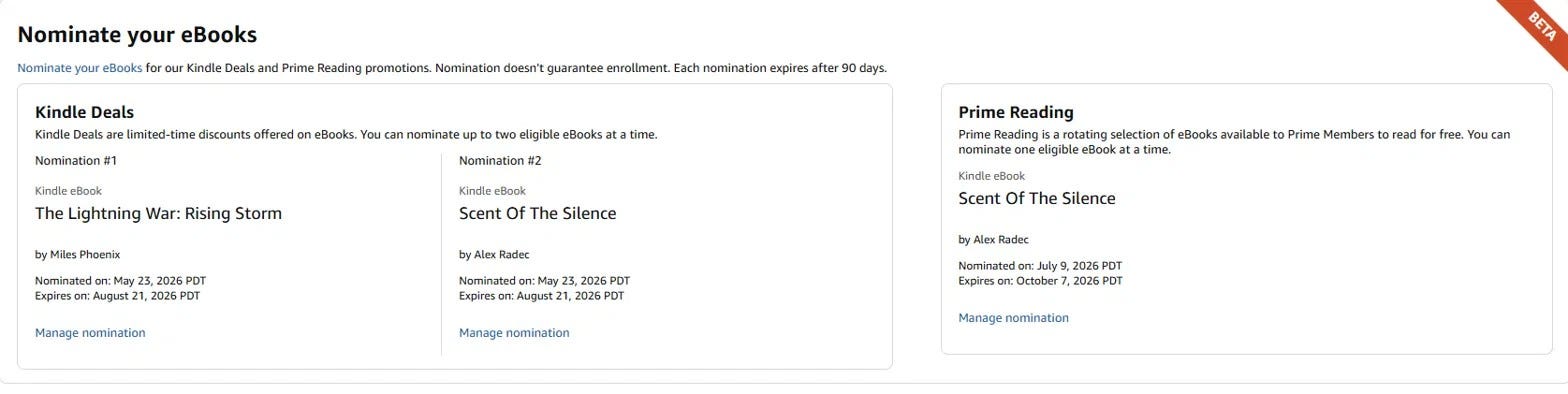
Seven weeks ago I nominated The Lightning War: Rising Storm and Scent of the Silence for Kindle Deals. Ninety-day window, no cost, two clicks. This morning I got a notification that an earlier nomination had expired, so I went back in and nominated Scent of the Silence for Prime Reading too – a separate slot on the same dashboard page, one I hadn’t touched until today.
The interface still says “Beta.” A red ribbon, top right corner, like Amazon shipped this last Tuesday.
It didn’t. Roger Packer covered this exact self-nomination flow in November 2020. Five years of “Beta.” That’s not a beta, that’s a label Amazon never bothered to remove, and it matters for how you should read everything else on that page – including the eligibility numbers, which don’t even agree with themselves depending on which corner of KDP’s help docs you’re standing in.
What you’re actually nominating for
Two separate programs live under one button.
Kindle Deals is a price cut. Your book goes from full price to a discounted price for a window Amazon controls – a day, a week, sometimes longer. You keep your normal royalty on the discounted price. Not half of it, not some reduced beta rate. During the current terms, that’s still 70% even if the deal price lands under $2.99, which is the one detail worth sitting with because it inverts the usual KDP math.
Prime Reading is different math entirely. Your book goes into the free-to-read pool for Prime members. You are not paid for those reads. Full stop. No KENP, no borrow fee, nothing – Amazon’s help documentation is explicit that this sits outside the Kindle Unlimited page-read economy. What you’re trading is exposure for direct revenue on that specific title, and whether that trade pays off runs through your backlist, not through the book itself.
Every “why did my royalties barely move but my rank jump” thread on KBoards traces back to authors not knowing that distinction going in.
The eligibility numbers don’t match each other
KDP’s official nomination help page says Kindle Deals wants a book priced $2.99–$12.99, live at least 90 days, not discounted in the past 90 days, on the 70% royalty plan, US marketplace. Fine. Except half the third-party breakdowns of the same program – Just Publishing Advice among them – cite $2.99–$9.99. That’s not a rounding error. That’s the exact boundary of the 70% royalty band under KDP’s standard pricing rules, and it’s the number authors have been repeating since the old email-invitation era.
My read: nominate inside $2.99–$9.99 and stop worrying about it. If Amazon’s actual ceiling really is $12.99 now, you lose nothing by staying conservative. If it’s still $9.99, you avoid getting quietly filtered out for reasons the dashboard won’t explain.
Prime Reading eligibility is simpler and harsher: KDP Select enrollment, no explicit price band mentioned, and reviews plus sales history doing the real gatekeeping. Amazon’s own language names “reviews, sales, broad appeal, and timeliness” as the selection inputs. Notice what’s missing from that list – nothing about how well-written your query letter is, because there’s no query letter. You nominate, or Amazon decides on its own, and the nomination form itself has no visibility into which one actually gets you selected.
Nobody knows the odds, and that’s the honest answer
I went looking for a selection rate. A percentage, anything. It doesn’t exist publicly, and after digging through KBoards threads going back years, the pattern that emerges isn’t reassuring: authors who self-nominate report going months without a response far more often than authors who describe getting an unsolicited email from Amazon first. “Most who get accepted are invited” is the closest thing to a consensus in that community, and it’s not backed by anything harder than repeated anecdote.
So the self-nomination button might function less like an application and more like a mailing list you opt into – a way of telling Amazon’s algorithm “yes, consider this title” rather than a queue with a review process behind it. I can’t confirm that. Amazon hasn’t published anything that confirms or denies it. What I can tell you is that the evidence points toward reviews and sales velocity doing almost all the work, and the nomination itself doing very little beyond making you eligible to be picked.
What actually happens when you get picked
This is where the data gets more interesting than the marketing copy.
David Kadavy’s documented case is the clean version: a $9.99 title cut to $1.99 for one day sold 422 copies against 3 the day before. Fourteen thousand percent, in his own accounting, and he kept the 70% royalty at the discounted price – about $575 for a promotion that cost him nothing to run. His book hit roughly #352 overall in the Kindle store that day. K-lytics’ aggregate numbers across multiple Daily Deals back this up in shape if not in exact size: average volume uplift around 1,122%, sales still running 209% above baseline for several days after the deal ended.
Then there’s the counter-case that never makes it into the marketing emails. An author on KBoards ran a $9.99 box set at $1.99 for thirty days and called the result “a wash.” More units, sure. But a long box set eating a discounted-sale royalty instead of generating KENP reads inside KU is often the worse trade, because a full read on a title that clears the 3,000-page cap pays more than a $1.99 sale ever will. Same program, opposite outcome, and the difference wasn’t luck – it was book length and format working against the promo structure.
Kindle Deals rewards short, front-of-series, low-friction titles. It punishes long box sets that were already earning well inside KU. That’s not a hunch. That’s what happens when you run the royalty math on both scenarios side by side.
Prime Reading tells a similar bifurcated story. Rank jumps are consistently reported – one author went from roughly 17,000 to 3,000 overall; another sat in the top 50 of their category for over a month. But the revenue story on the featured book itself is often flat or slightly down, because every Prime read that would have been a paid sale or a KU borrow becomes an unpaid read instead. The money shows up downstream, in the rest of the series, when it shows up at all. Several authors report their other titles tripling in sales during a Prime Reading run. Others report nothing – “no measurable benefit” is a direct quote from more than one thread.
The variable that seems to separate the wins from the shrugs isn’t the program. It’s whether there’s a series behind the featured book for that exposure to convert into.
The review-quality risk nobody puts in the pitch deck
A handful of authors on KBoards and in KDP Community threads report their star rating dipping after a Prime Reading run – readers sampling outside their normal genre, leaving a review anyway. One author estimated roughly a 0.2-star drop. This is thin evidence, a few threads, not a study, and I’m flagging it as exactly that. But it’s the kind of risk that doesn’t show up until after you’ve already accepted, and Amazon’s decline option only works before enrollment, not after your rating starts drifting.
If your star rating is doing real work for your ad conversion, that’s worth weighing before you say yes to an invitation, not after.
What I’m actually doing with my own nominations
Rising Storm stays nominated for Kindle Deals – it’s a series opener, priced inside the safe $2.99–$9.99 band, and if it gets pulled the downside is close to zero. Nominating Scent of the Silence for Prime Reading was a deliberate call, and it’s also a series starter, so the trade lines up with what the data suggests works: give up direct revenue on one book, let the read-through carry the rest of the catalog.
What I’m not doing is nominating anything from the Lightning War box sets. The KENP math on those is too favorable inside KU to risk trading it for a discounted-sale royalty on a program where I can’t even confirm my nomination did anything.
I’ll have real numbers on the Prime Reading run in a few weeks – KENP movement across the rest of the Alex Radec catalog, rank data, whatever shows up in the reports Amazon actually lets me see. Whether the halo shows up the way the KBoards threads predict, or whether this becomes another line in the “no measurable benefit” column, is the part nobody’s help page can answer in advance.
Geez, yes. Five years of a beta ribbon is peak friggin' Amazon energy, isn't it. They'll rebuild the whole search algorithm before they dare touch a UI label. I also appreciated you flagging the price band discrepancy between the official page and third party sites. Man. I've been quietly following the more conservative number for ages without knowing why it felt safer. Makes sense. Thanks for writing this!