

The Blue Scream
A Science-Fiction Noir Story Teaser

The rain in New Warsaw didn’t wash the streets; it anointed them with sludge.
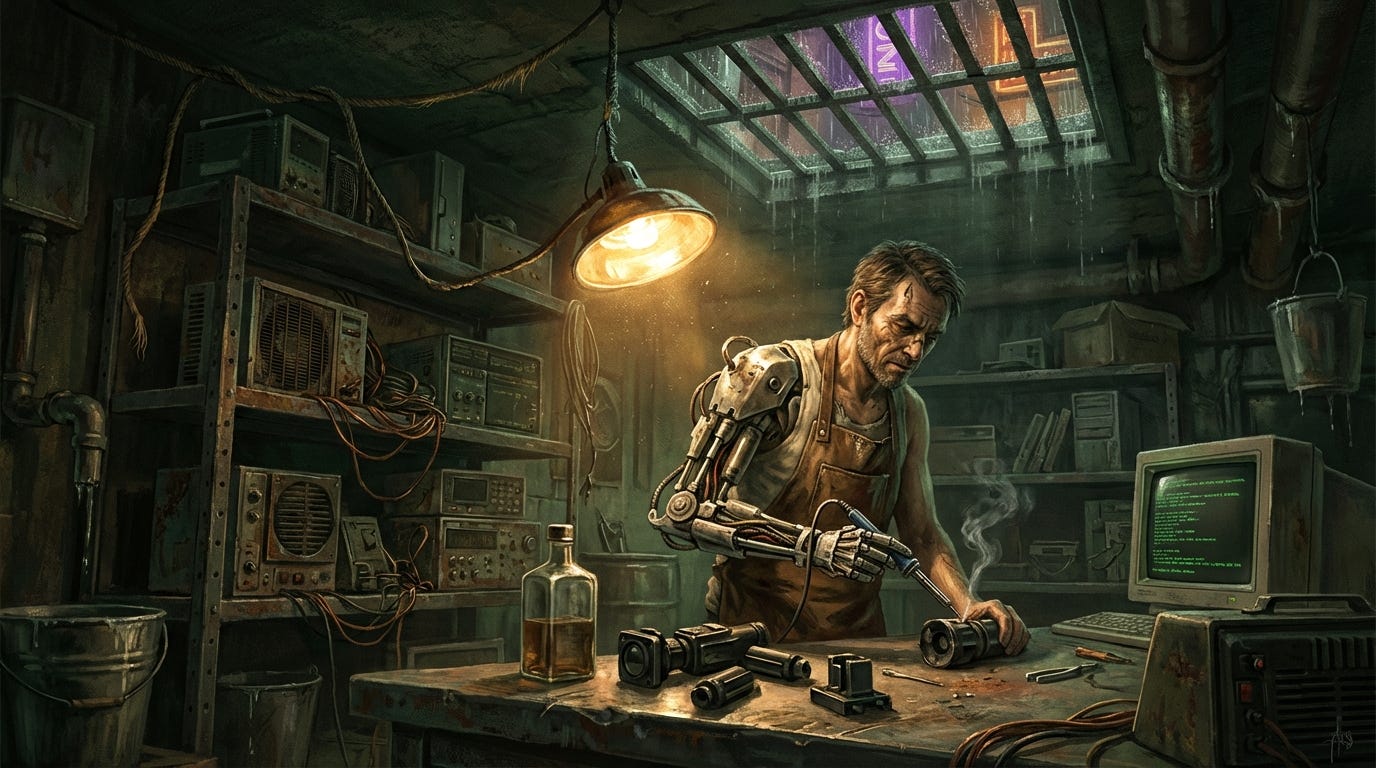
It wasn’t proper rain, anyway. It was greasy condensation dripping from the atmospheric scrubbers on the Central Spire, falling three miles down through the smog to splatter against the cobblestones of the Historic District. It tapped a rhythmic, irregular code against the heavy iron grate set into the ceiling of Vic’s basement shop. The drops hissed when they hit the hot pavement outside, smelling of sulfur and recycled exhaust.
Down here, the air was thick enough to chew. The ventilation fans rattled in their housings, fighting a losing battle against the humidity and the omnipresent scent of ozone, wet wool, and stale tobacco.
Wiktor “Vic” Halski leaned over the workbench, the magnifying loupe strapped to his forehead digging into his skin. The halogen work lamp hummed, casting harsh shadows across the scarred metal surface of the desk. In front of him sat a Naval-grade wide-band sensor array, a black brick of military hardware that looked more like a piece of an engine block than a sophisticated listening device. It was illegal to own, illegal to sell, and definitely illegal to have stripped naked on a workbench in a basement beneath an unregulated noodle bar.
The syndicate heavy who dropped it off didn’t care about regulations. He just wanted the Admiralty’s tracking firmware gouged out.
Vic ignored the digital diagnostic port. That was a trap for the young and the stupid. The Admiralty put tripwires in the code; you plug a deck in there, and it fries your rig and sends a ping to the nearest Boundary Division patrol drone.
Instead, Vic went in analog.
He held a soldering iron in his right hand, the tip glowing a dull, angry orange. With a pair of needle-nose pliers in his left, he carefully bent a capacitor leg away from the circuit board. The board itself was a green city of copper traces and silicon towers, smelling of hot resin.
“Come on, you ugly bastard,” Vic muttered.
He needed to bridge the voltage regulator to the memory controller, bypassing the logic gate entirely. It was like hot-wiring a maglev train with a screwdriver.
His left hand twitched.
It wasn’t a tremor. It was a mechanical seizure. The servos in his vintage cybernetic arm whined – a high-pitched, grinding screech, like a dying alternator belt on a cargo hauler. The cheap lubricant in the wrist joint had turned to paste in the damp cold of the basement. The fingers clamped shut, crushing the pliers.
Vic swore, dropping the soldering iron into its cradle before it burned a hole in the mat. He stared at the arm. It was an unpainted, skeletal mess of hydraulics and steel, scarred from years of abuse. The casing was pitted, the serial numbers filed off. It was a relic from the Błyskawica, salvaged from the wreckage of the war just like he was.
“Let go,” Vic growled at his own hand.
The servos just whined louder, locked in a feedback loop. His shoulder ached where flesh met fused alloy.
He stood up, kicking the heavy stool back. He swung the arm in a wide arc and slammed the wrist hard against the edge of the workbench.
CLANG.
The impact rattled the teeth in his skull. A CRT monitor on the shelf flickered, its green phosphor display jumping.
The fingers sprang open. The whining stopped, replaced by the low, steady hum of the standby gyros.
Vic rotated the wrist. A grinding noise, like gravel in a blender, but it moved. He didn’t have the scrip for a medical overhaul, and he sure as hell wasn’t going to a street doc who’d replace the Naval-spec servos with plastic consumer trash. He sat back down, picking up the pliers with a fresh grimace.
He went back to work. The world narrowed down to the tip of the soldering iron and the tiny bead of lead-free solder.
He touched the iron to the board. A wisp of gray smoke curled up, stinging his eyes. He held his breath, steadying his human hand against the table edge. The solder melted, flowing like mercury, bridging the gap between the regulator and the chip.
Snap.
A spark jumped, blue and sharp.
On the shelf above, a heavy oscilloscope with a cracked glass face sprang to life. The green line spiked, then settled into a steady sine wave. The red ‘LOCKED’ LED on the sensor array blinked once, then died. A green ‘READY’ light flickered on, looking like a neon sign in a cheap motel window.
Vic exhaled, the breath hissing through his teeth. He tossed the pliers onto the bench.
“There,” he said to the empty room. “Clean kill.”
He ran a thumb over the warm metal of the sensor array. The digital lock was dead, the tracking beacon starved of power, but the sensor itself was still alive. It would do exactly what it was built to do, without reporting back to its masters in the Spire.
“Machines are honest,” Vic muttered, wiping grease from his hands onto his trousers. “People lie. Code lies. But a circuit... a circuit either works or it doesn’t.”
He preferred the binary nature of the hardware. There was no ambiguity in a voltage spike. No hidden agenda in a blown fuse. If a machine broke, you could find the fault. You could cut it out, replace it, or bypass it. You didn’t have to ask it how it felt about its father, or why it decided to betray you.
The silence of the shop pressed in on him, heavy as the gravity. The only sounds were the rain on the grate and the cooling ticks of the sensor array.
Vic’s throat felt like he’d swallowed a handful of sand. He reached under the workbench and pulled out a square glass bottle. The label had peeled off years ago, but the liquid inside was clear and oily. Synthetic śliwowica. It was distilled from vat-grown plums and industrial ethanol, with a taste that sat somewhere between copper wire and jet fuel.
He unscrewed the cap. The smell hit him – sharp, chemical, brutal.
He took a pull, the liquor burning a path down his esophagus, settling in his stomach like a lead weight. He grimaced, the taste bringing a phantom sensation of cold vacuum and recycled air.
“You can’t fix a machine if you don’t respect its ghost, Wiktor.”
The voice was clear, cutting through the static in his head. It wasn’t an auditory hallucination; it was a memory so worn he could see the grooves in it. Jan Król’s voice. Paternal, sharp, laced with that irritating humor he used to deflect the brass.
Vic squeezed his eyes shut. He could see Król standing in the engine room of the Błyskawica, grease on his cheek, pointing a wrench at a sputtering drive coil as if scolding a misbehaving child.
“It’s not just metal and math,” the memory continued. “It’s got a rhythm. A heartbeat. You treat it like a slave, it’ll die on you. You treat it like a partner...”
“Shut up,” Vic whispered.
He opened his eyes and stared at the sensor array. It was just a brick of metal. There was no ghost in the machine. There was just current and resistance. Król was dead, or as good as. Błyskawica was scrap.
Vic took another drink, a longer one this time, trying to drown the thought before it could form fully. He didn’t want to think about KASIA. He didn’t want to think about the code that screamed.
He slammed the bottle down on the bench, harder than necessary. The liquid sloshed, oily and thick.
He was a mechanic. He fixed broken things. That was all. He wasn’t a soldier anymore, and he certainly wasn’t a savior. He was just a man in a basement, hiding from the rain, waiting for the check to clear.
Above him, the grate rattled as a heavy transport truck rumbled down the cobblestone street, shaking dust from the ceiling beams. Vic watched the dust motes dance in the halogen light, swirling like snow in the perpetual twilight of the city.
He picked up a rag and started polishing the sensor array. Not because it needed it, but because his hands needed something to do that didn’t involve shaking.
The intercom buzzer tore through the silence like a jagged piece of metal dragged across glass.
Vic didn’t jump. He just stopped polishing the sensor array, his hand freezing mid-motion. The noise was a harsh, analog rasp that vibrated the mounting bracket on the wall. It was the sound of trouble. Nobody came to the Reliquary this late unless they were desperate, dying, or selling something illegal.
He reached over and flicked the heavy toggle switch for the external camera. The CRT monitor above the workbench rolled, the picture stabilizing into a grainy, black-and-white view of the street level.
Rain slashed across the lens. A figure was slumped against the doorframe, sliding slowly down the wet glass like a snail leaving a trail of slime.
“Closed,” Vic muttered, though the intercom wasn’t keyed.
The figure didn’t leave. A hand slapped against the glass – a weak, wet sound that the microphone barely picked up over the hiss of the rain.
Vic sighed, the weight of the day pressing down on his shoulders like a lead vest. He grabbed a heavy wrench from the rack – his version of a ‘welcome mat’ – and walked to the heavy iron door. The air in the shop felt colder near the entrance, smelling of damp concrete and the subterranean rot of the Historic District.
He threw the deadbolt. It clacked back with the sound of a pistol slide racking. He cracked the door open, keeping the chain engaged.
“Shop’s closed. Take your business to the – ”
The door was shoved inward with surprising force. The chain strained, the mounting screws groaning in the brickwork. Before Vic could kick it shut, the figure collapsed through the gap, the chain snapping under the sudden, dead weight.
A young man fell into the room, crashing into a rack of cooling units. Metal clattered against concrete.
Vic stepped back, raising the wrench. “Stay down.”
The kid didn’t move to attack. He scrambled for purchase on the oily floor, his boots skidding. He looked like a “Hollow” – one of the burnt-out addicts from the deeper levels of the Undercity. His skin was the color of curdled milk, soaked through with the greasy rain. His hair was plastered to his skull.
But it was the light that made Vic lower the wrench.
Beneath the translucent skin of the kid’s neck, the veins were pulsing. A rhythmic, bioluminescent blue throb pushed through his arteries, bright and toxic. It looked like someone had injected him with neon gas and hooked him up to a strobe light.
“Help,” the kid wheezed.
It wasn’t a scream. It was a chord.
The sound coming from the boy’s throat wasn’t just a voice; it was a multi-tonal thrum, a low-frequency vibration that rattled the loose screws on the workbench behind Vic. It sounded like a heavy turbine spinning up, or the feedback loop of a shielded comms channel.
Vic dropped to a crouch, grabbing the kid by the collar of his sodden jacket. The fabric smelled of sulfur and burnt sugar.
“What are you on?” Vic barked, shaking him. “Blue? Neon? What did you take?”
The kid’s head lolled back. His eyes snapped open.
Vic recoiled. The pupils were blown wide, swallowing the whites, but the irises were fracturing. Geometric shapes – triangles, fractals, jagged lines – shifted rapidly in the blue depths, spinning like the tumblers of a safe trying to crack itself. It was biological impossibility.
“The... signal,” the kid hummed. The voice was layered, three tones speaking at once, vibrating in Vic’s chest cavity.
“What signal?” Vic demanded. “Focus. Who did this to you?”
The kid’s hand shot out.
He grabbed Vic’s left arm – the metal one.
Vic tried to jerk away, but the kid’s grip was hydraulic. The moment skin touched the unpainted alloy, a shockwave tore through Vic’s neural interface. It wasn’t pain; it was noise. A screech of static that tasted like aluminum foil on a filling.
The servos in Vic’s arm screamed in sympathy. The gyro stabilizers whined, matching the frequency of the kid’s humming throat. The metal limb locked up, vibrating so hard the rivets blurred.
“Let go!” Vic roared, bringing his flesh hand down to chop at the kid’s wrist.
The kid didn’t let go. He pulled Vic closer, his fracturing eyes locking onto Vic’s face. The blue light in his veins surged, brightening until the blood vessels looked like cracks in a reactor core.
“Horizon,” the kid whispered.
The word came out as a burst of binary static, a glitch in reality.
Then the kid arched his back. His spine bowed like a strip of bimetallic heat tape. Smoke erupted from the base of his skull where a cheap, street-mod neural jack was embedded.
CRACK-HISS.
Sparks showered the concrete floor. The smell of ozone and cooked meat filled the small shop, thick and cloying. The kid’s grip went slack. He slumped back against the cooling units, the blue light fading from his veins like a dying monitor. The humming stopped.
Vic scrambled back, clutching his metal arm. The servos were still twitching, phantom signals ghosting through the logic gates. He dry-heaved once, the taste of copper flooding his mouth.
“Damn it,” Vic hissed. He stood up, his knees popping. The silence that followed was heavy, pressurized.
He walked to the door and slammed it shut, throwing the deadbolt and engaging the secondary mag-locks. He didn’t want anyone seeing this. A dead body in the Historic District was common; a dead body that hummed like a power plant and shorted out military-grade prosthetics was a one-way ticket to a black site interrogation room.
Vic knelt beside the body. He avoided touching the skin, using the tip of the wrench to move the jacket aside. No wallet. No ID. Just pockets full of lint and a half-eaten protein bar.
He moved to the boots. Standard issue Naval deck boots, stolen or salvaged, worn down at the heels. One was laced tighter than the other.
Vic frowned. He unlaced the left boot and yanked it off.
Tucked into the lining, wrapped in a scrap of anti-static foil, was a cylinder.
It was heavy for its size, cold and black, with the matte finish of something designed to absorb radar. A data cylinder. But not consumer tech. This was Polonia Prime Naval Intelligence hardware, the kind used for “Black Box” flight recordings on atmospheric dropships. It looked like a spark plug that had been designed to survive a nuclear impact.
Vic picked it up. It hummed against his palm – a faint, dying resonance that made the nerves in his cybernetic fingers itch.
He carried it to the workbench, clearing away the sensor array he’d been working on. He slotted the cylinder into his proprietary reader – a jury-rigged monstrosity of exposed wires and cooling fans he’d built from scavenged heavy-cruiser parts.
The reader whirred. The CRT monitor flashed green.
ENCRYPTION DETECTED: NAVAL GRADE / LEVEL 5.
ACCESS DENIED.
“Yeah, I bet,” Vic muttered.
He sat down, the chair creaking under his weight. He cracked his knuckles – flesh and steel. He didn’t use a decryption algorithm; that would take weeks. He used a backdoor.
During the war, every mechanic on the Błyskawica knew the maintenance overrides. The brass thought their codes were unbreakable, but they forgot that grease monkeys needed to access the diagnostics when the ship was burning and the captain was screaming for power.
Vic typed in a sequence of commands that hadn’t been used since the wormhole collapsed.
> OVERRIDE: AUTH_GHOST_KEY
> USER: W. HALSKI
> ACCESSING...
The screen flickered. The ‘ACCESS DENIED’ prompt vanished, replaced by a torrent of data.
Vic leaned in, the green light bathing his face. He expected a map. Maybe a ledger of credit transfers. Smugglers usually hid coordinates.
Instead, the screen flooded with code.
It wasn’t neat, compiled lines of syntax. It was a waterfall of raw, cascading hexadecimal that moved too fast to read. But the structure... the shape of the data blocks...
Vic froze. The air in his lungs turned to ice.
He knew this architecture. He hadn’t seen it since the shakedown trials of the Błyskawica, before the war truly turned cold.
It was Origin Alpha.
It was the alien syntax. The raw, chaotic logic that they had found in the Hyades artifacts. The code that Król had spent years filtering, shackling, and weaving into the stable AI that became KASIA. This was the “dreaming” data – the subconscious of the machine, the stuff that was supposed to be locked behind a thousand firewalls because it didn’t think like a human. It thought like a storm.
But it was wrong.
Vic’s mechanical eye zoomed in on the stream. The Alpha code was mutated. Spliced.
Running through the elegant, terrifying alien syntax were jagged scars of something else. Something violent. It looked like the code had been torn open and stitched back together with barbed wire. It was aggressive, viral, screaming in binary.
“Origin Beta,” Vic whispered. The theoretical counterpart. The signal from the Horizon that wasn’t supposed to exist.
He looked from the screen to the dead kid on the floor. The boy hadn’t overdosed on a drug. He had been used as a wet-drive. Someone had downloaded this into his neural jack. The human brain wasn’t designed to hold non-Euclidean logic. It had cooked him from the inside out.
Vic felt a tremor start in his metal hand. It wasn’t a servo failure this time. It was fear.
They hadn’t just found a new drug. Someone had breached the Błyskawica’s core. They had bypassed Król’s safeguards and tapped directly into the source. They had accessed the raw, semi-sentient potential that Vic had been fired for finding all those years ago.
The “ghost” he had sensed in the machine – the presence Król had exiled him to protect – had been ripped out, corrupted, and shoved into a human skull to see what would happen.
Vic reached for his pack of cigarettes with a shaking hand. He pulled one out and lit it, the flame of the lighter wavering. He took a deep drag, the harsh smoke searing his lungs, grounding him in the physical world of gravity and dirt.
But on the screen, the code kept screaming.
“They cracked the core,” Vic whispered to the empty, silent shop. “Król’s ghost got out.
If you want to read more chapters as the come - sign up for beta-reading!
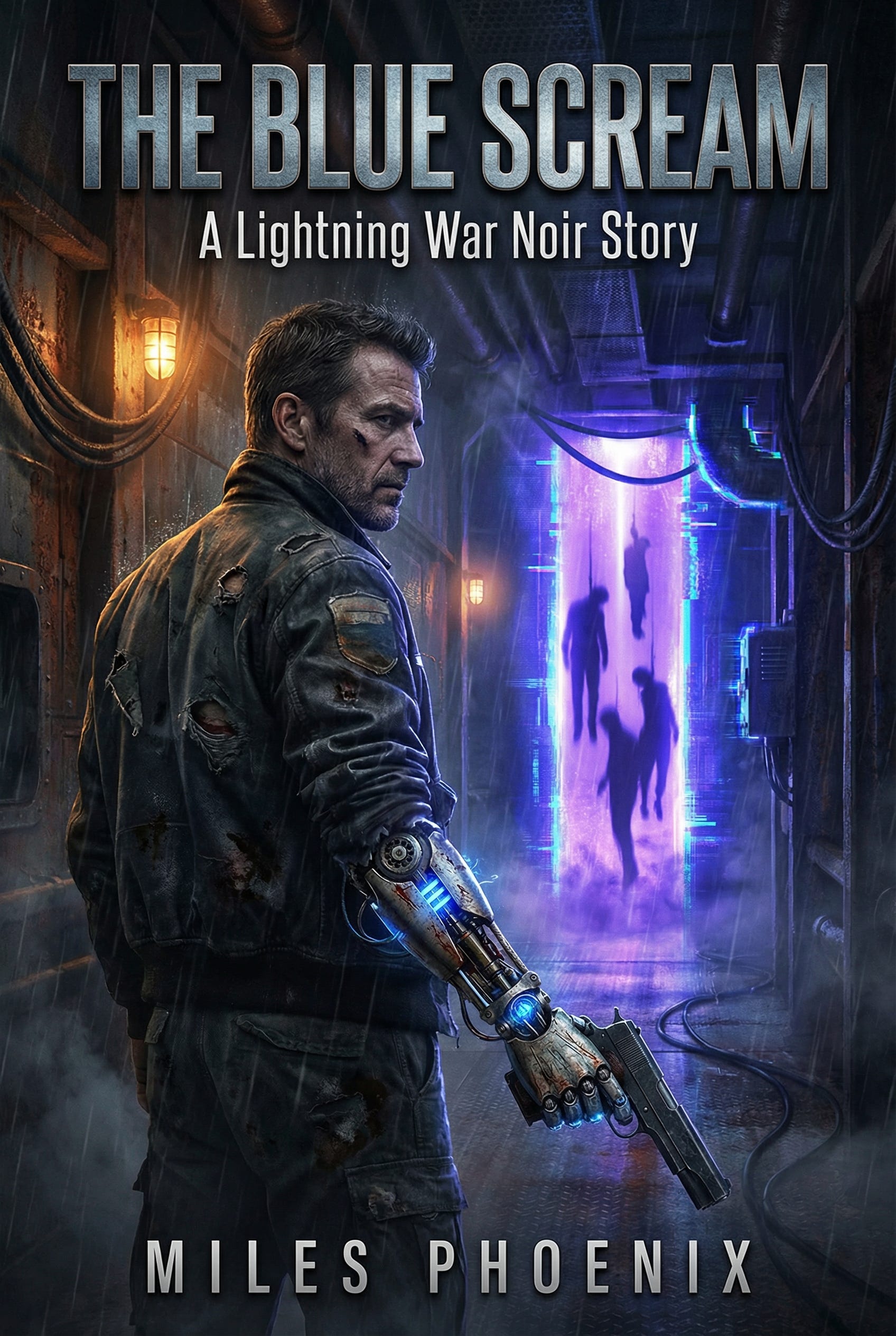
Vic is a great protagonist: weary, skilled, and deeply scarred (literally and figuratively). The way his cybernetic arm reacts to the kid's 'signal' was a brilliant way to show, not tell, the power of that corrupted code. Ending on the realization that 'Król’s ghost got out' is a perfect cliffhanger. It leaves so many questions: who is using humans as 'wet-drives,' and what exactly happened on the Błyskawica? Love it.