

What the Hell is Ad Fatigue?
And Why Facebook is Bleeding Your Book Budget Dry

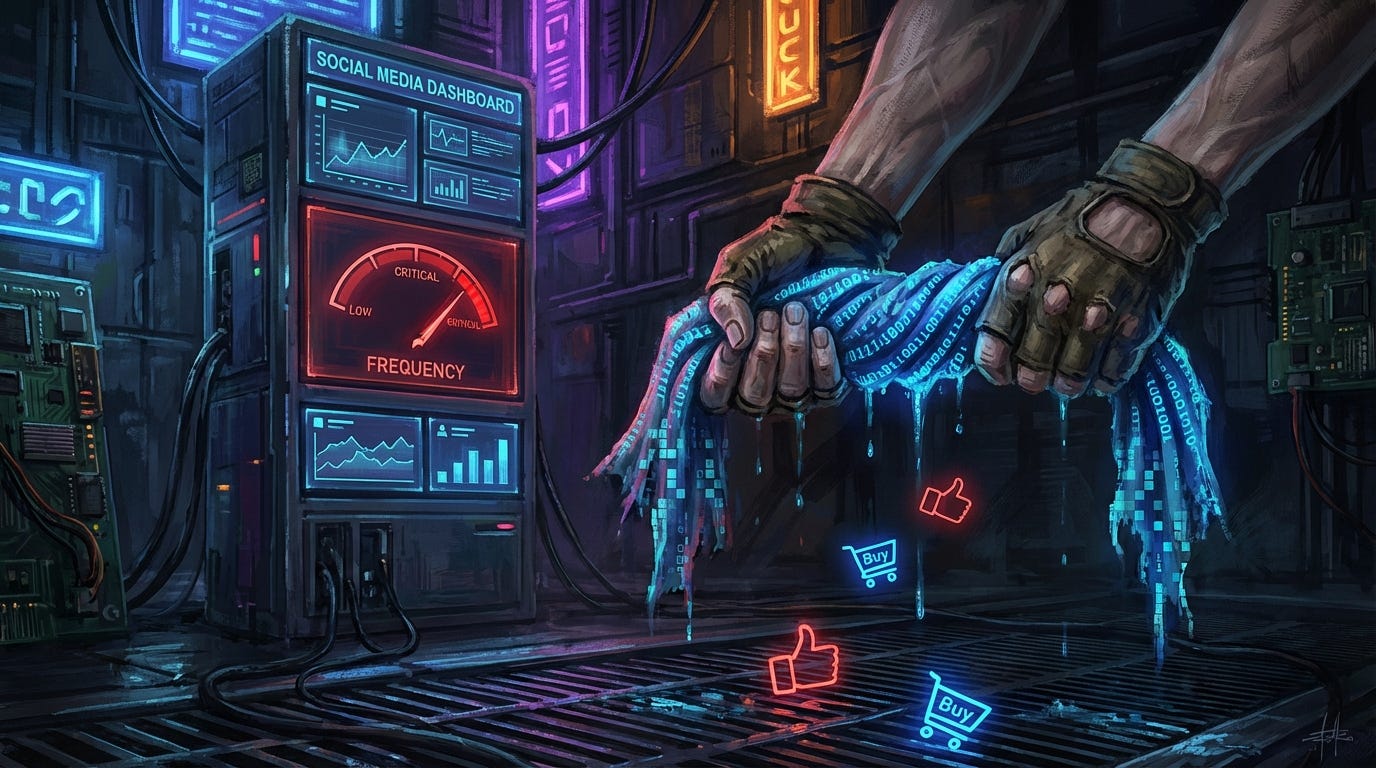
You have a potential reach of one million readers. You set your budget, hit “publish,” and wait for the floodgates to open.
But three days later, you’re staring at a dashboard that makes zero sense.
Your ad reached 10,000 people. Fine. But your “Frequency” is a 3.0. That means those same 10,000 people have seen your book cover three times each, while 990,000 other potential fans are sitting in total darkness.
You’re paying to annoy a small pocket of people instead of meeting new ones. This isn’t a glitch. It’s the Meta “Total Value” auction doing exactly what it was built to do: minimize risk for Facebook, not maximize discovery for you.
The “Safe Bet” Trap
Facebook doesn’t care about your “Potential Reach.” That number is a ghost.
The algorithm operates on something called Estimated Action Rate (EAR). It’s a cold, hard calculation of how likely a specific user is to click your “Buy” button right now.
Out of your million targets, there’s a small slice – maybe that 10,000 – who have high intent signals. They buy books often. They click on covers like yours. They are the “High-EAR” segment.
The other 990,000? They’re “cold.” Reaching them is an economic risk.
The algorithm looks at User A (who has seen your ad four times but loves your genre) and User B (who has never seen you and might not care). It calculates that showing the ad to User A for the fifth time is still more likely to get a click than showing it to User B for the first time.
It chooses the path of least resistance. It chooses to “ring the towel dry” rather than go get a new towel.
Banner Blindness: The Silent Killer
This is where “Ad Fatigue” turns into a death spiral.
Human attention is a finite resource. When a reader sees your cover for the first time, it’s a novelty. By the third time, their brain has categorized it as “noise.” By the fifth, they’re actively annoyed.
This is Banner Blindness. Once your frequency climbs and your Click-Through Rate (CTR) tanks, the algorithm smells blood in the water. It sees that people are ignoring you, so it raises your costs. You end up paying more for the privilege of being ignored by the same 10,000 people.
Why You Shouldn’t Advertise Your Book There (Yet)
If you are an indie author starting from zero, the Facebook auction is a rigged game. To “force” the algorithm to find those other 990,000 people, you have to bid higher. You have to trade your profit margin for scale.
For most of us, that’s a losing bet.
You’re competing against “Liquid” audiences – pockets of users that the big players have already identified. Unless you have a massive budget to subsidize the “Learning Phase,” the system will retreat into the safety of your small, fatigued pool every single time.
Where to Actually Put Your Dollars: The High-Intent Pivot
If you have $5 a day, don’t give it to Zuckerberg. Give it to Bezos.
Amazon Ads (AMS) are fundamentally different because they are intent-based. On Facebook, you are interrupting someone’s dinner to show them a book. On Amazon, they are already in the bookstore with their credit card out.
The “Frequency” trap is much harder to fall into on Amazon because you are targeting keywords and “customers also bought” slots. You aren’t chasing a “profile”; you’re chasing a “search.” If your book is a Psychological Thriller, bidding on “Gillian Flynn” puts you in front of people actively looking for their next fix.
The conversion rate is higher because the friction is lower. One click, one purchase.
The Low-Budget Discovery Engine: TikTok vs. Substack
If your budget is zero, you need to exploit organic algorithms that actually favor new voices.
TikTok (The Lottery Ticket): TikTok is the only major social platform where a 0-follower account can get 10,000 views overnight. Why? Because its algorithm rewards content quality over follower count. Use it for the “Top of Funnel” – short, raw videos of you talking about your tropes. Don’t polish it. The more it looks like an ad, the faster people swipe.
Substack (The Trust Builder): This is where you move those TikTok viewers. On Substack, you own the relationship. There is no EAR calculation between you and your subscriber’s inbox. When you publish, 100% of them get the email.
The Strategy for 2026
Stop paying for “interruptions.” Start paying for “intent.”
Run small, surgical Amazon ads to find your first 100 buyers. Use TikTok to find your “lookalikes” for free. Then, pull them all into your Substack where the algorithm can’t hold your audience hostage ever again.
The house always wins at the auction. So stop playing.
TikTok depends on genre, and it's become a cesspool on top of that. I know it works for some people, but I have tried this approach with zero results. Amazon Ads was just burning money for me. Facebook ads are the only thing that works for me since I have a 6 book series. Substack just seems like so much work - I see the effort YOU are putting in here! Keep the articles coming.
The fastest way I ever burned money was paying for FB and LinkedIn ads when I was just starting out. I really like your advice to focus on "free" platforms, especially in the early stages of establishing yourself and your audience.
I've love some insights on to how to get interest from TikTok to join the Substack newsletter. I've had VERY little success with TikTok.